Flea and tick control in Dallas County requires addressing the specific biology of pests thriving under warm, humid conditions. In shaded, established grounds near White Rock Lake, the Dallas Arboretum and Botanical…
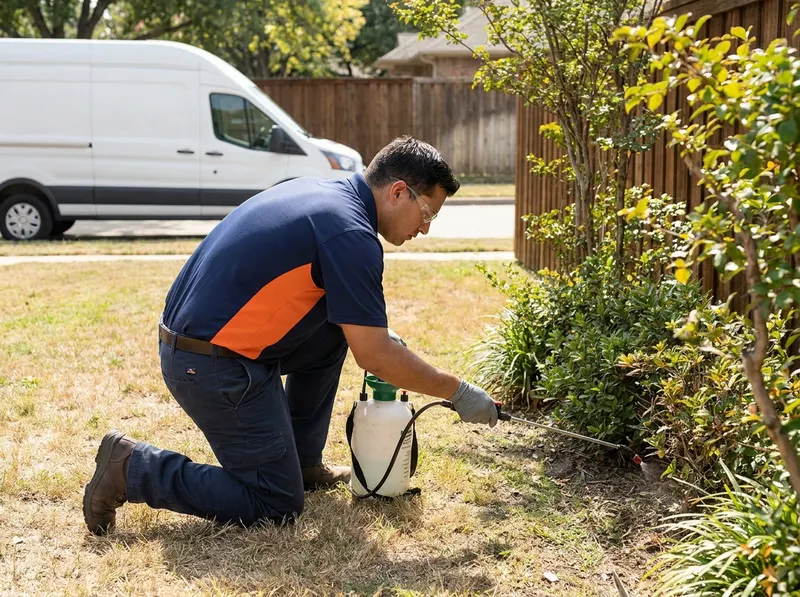
Flea and tick control in Dallas County requires addressing the specific biology of pests thriving under warm, humid conditions. In shaded, established grounds near White Rock Lake, the Dallas Arboretum and Botanical Garden, and properties throughout Lakewood and Lake Highlands, dense canopy cover and high humidity create shelter for flea larvae and tick nymphs. Lone star ticks and brown dog ticks frequent tall turf and ground cover around tree lines, requiring liquid adulticide barriers applied via high-pressure sprayers directly to mulch beds, leaf litter, and turf perimeters. A complete yard program targets fence lines, shaded dog runs, and low shrubbery where wild animals or domestic pets rest.
Interior treatments solve infestations that spread beyond exterior walls into floor coverings and upholstery. In historic pier-and-beam homes common to Kessler Park, the M Streets, and Oak Cliff, flea pupae shelter in subfloor seams, baseboard cracks, and crawlspace entries where outdoor rodents leave parasites behind. Vacuuming prior to treatment stimulates flea emergence from protective cocoons, allowing the applied insect growth regulator pyriproxyfen and synthetic pyrethroids to make contact with adult pests. Unlike standard broad-spectrum pest sprays that only eliminate active adult biters, dedicated flea and tick protocols deploy an insect growth regulator to disrupt chitin synthesis, halting the molting of juvenile instars and sterilizing viable egg deposits.
Decision guidance depends on property layout and infestation severity. For a standard 2,500-square-foot home on a quarter-acre lot in Far North Dallas or Preston Hollow with low pest presence, an exterior-only perimeter treatment often suffices to block tick migration from adjacent greenbelts. When pets actively scratch inside the home or show parasite presence, choosing an exterior-only treatment leaves surviving pupae embedded in indoor rugs, leading to re-emergence within 14 to 21 days; an integrated dual-zone interior and exterior protocol is necessary in those instances. The operational trade-off of whole-home treatment is a mandatory 2-to-4-hour vacancy window following indoor applications to allow microencapsulated sprays to dry thoroughly before children and animals return to treated surfaces.
1. Initial property assessment: The technician walks the grounds, inspecting turf, pet runs, shaded beds, crawlspace access points, and interior flooring.
2. Cultural preparation: The occupant clears lawn debris, mows grass below 3 inches, vacuums all carpeted areas thoroughly, and discards the vacuum canister contents outdoors.
3. Application: The technician applies liquid residual barriers and insect growth regulators to the exterior perimeter and interior carpet fibers.
4. Follow-up evaluation: A secondary inspection or touch-up treatment occurs 14 days later to address newly emerged adults before they reproduce.
Every job gets a firm, written price after a free on-site visit.
Tell us about your flea and tick control job in Dallas and we'll send a clear, written quote, usually the same day.
 Elvanta Pest Pros