Rodent exclusion differs fundamentally from recurring exterior chemical baiting. Chemical bait stations placed around a perimeter reduce exterior population pressure, but toxic baits left inside living areas risk…
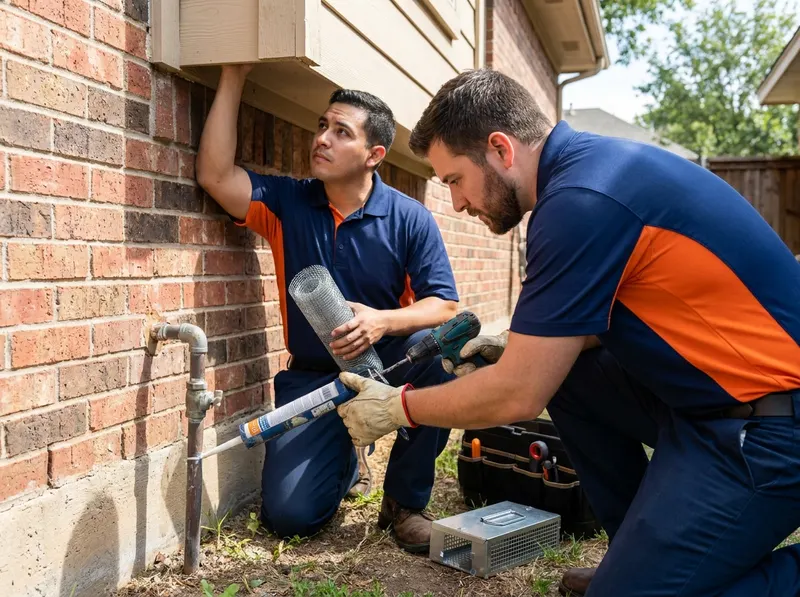
Rodent exclusion differs fundamentally from recurring exterior chemical baiting. Chemical bait stations placed around a perimeter reduce exterior population pressure, but toxic baits left inside living areas risk rodents dying inside drywall cavities, creating severe odor and fly issues for 14 to 21 days. True abatement pairs physical exclusion with lethal interior mechanical trapping. Technicians identify gnaw marks, grease rub marks (sebum), and droppings along structural plates. All exterior penetrations larger than one-quarter inch are mechanically sealed using 24-gauge galvanized steel hardware cloth, copper wire mesh, silicone elastomeric sealants, or hydraulic cement. Expanding spray foam alone is avoided because rodent incisors exert up to 7,000 pounds per square inch, easily chewing through unreinforced polyurethane.
Neighborhood architecture across Dallas County dictates specific exclusion vulnerabilities. In Lakewood, Kessler Park, and the M Streets, historic Craftsman bungalows and mock Tudor residences often feature pier-and-beam foundations with crawlspace vents where settling leaves gaps greater than 0.5 inches against the ground level. These structures also carry mature pecan and live oak canopies that overhang clay-tile or cedar-shake roofs, giving roof rats direct access to unmeshed dormer louvers and barrel-tile eave openings. In contrast, modern slab homes in Preston Hollow and Far North Dallas feature exterior brick weep holes every 3 to 4 feet along the foundation line. Norway rats and mice squeeze through standard 0.75-inch weep gaps directly into wall voids; technicians seal these using metal weep-hole inserts that preserve required wall ventilation while barring entry.
Structural entry remediation follows three sequential phases. Step 1: Technicians run an elevation audit mapping utility pipe penetrations, AC conduit lines, soffit overhangs, and roof ridge vents. Step 2: Mechanics install metal-clad physical barriers across all exterior transit routes, securing materials with coated screws rather than light staples. Step 3: Trapping occurs exclusively inside the sealed structural envelope using numbered snap traps deployed along active runway runs, checked at regular 3-to-5-day intervals until 14 continuous days of zero activity confirm complete interior depopulation.
For properties near riparian zones, including properties bordering White Rock Lake or the greenbelts around Trinity River Audubon Center and Lake Highlands, rat population density remains elevated year-round. An exclusion installation prevents continuous re-infestation from natural outdoor colonies without contaminating soil or domestic water run-off.
Every job gets a firm, written price after a free on-site visit.
Tell us about your rodent exclusion and abatement job in Dallas and we'll send a clear, written quote, usually the same day.
 Elvanta Pest Pros